
Small-scale detention is increasingly replacing large prison institutions across Europe. Many of these facilities are still new territory for monitoring bodies. A FRAME survey of the European NPM Forum found that only half of the responding National Preventive Mechanisms (NPMs) had visited a small-scale facility so far. Raising awareness, developing the right tools and taking into account NPMs’ capacity can help address that gap.
FRAME is a European project working to improve how small-scale detention is implemented and monitored across Europe. One part of this work is to help monitoring bodies develop the tools they need to assess detention houses.
At RESCALED, we are convinced that detention houses must be implemented in a responsible and sustainable way, with independent monitoring from the start. Our exchanges with the European NPM Forum, national monitoring bodies and local partners have helped us better understand both the challenges and the opportunities this creates.
Small-scale and within scope
Under Article 4 of the Optional Protocol to the Convention against Torture (OPCAT), any place a person is not free to leave at will can be a place of deprivation of liberty and must be open to regular visits from NPMs and the UN Subcommittee on Prevention of Torture (SPT).
Small-scale facilities fall within the mandate of monitoring bodies: the size of a facility, its management structure of a facility, or its categorisation in national law do not excuse States from their obligation to establish and maintain national preventive mechanisms and ensure access for visits by these mechanisms.
In 2024, the SPT clarified the scope of Article 4, calling for a broad interpretation of the term “deprivation of liberty”. As the understanding of this term varied across states, some NPMs faced difficulties or restrictions when visiting certain places. In rare cases also due to national legislation. 1
The SPT confirms that deprivation of liberty,, includes facilities whose management is outsourced or delegated to NGOs or other non-state actors. Responsibility however stays with the state: wherever people are deprived of their liberty in practice, preventive monitoring applies.
The SPT also makes clear that what matters is whether a person can leave in practice, not only on paper, and that a placement can amount to deprivation of liberty even when a person entered voluntarily.
The SPT and the European Committee for the Prevention of Torture (CPT) both stress that NPMs should have access to all places where people are deprived of their liberty.
This is relevant for many of the inspirational practices we have mapped: small-scale facilities, some run by prison administrations, others by NGOs, that are part of the community and focus on (re)integration. Some facilities support people who use drugs or experience homelessness, who are placed there instead of serving a prison sentence. Because such facilities can look more like care settings than a traditional prison, a stay may appear to be voluntary, and standards for social care may also apply.2
Beyond compliance: monitoring as a driver of good practice
Monitoring is first and foremost about preventing harm and protecting the rights of people deprived of their liberty. It can also do more than check minimum standards: it can help good practice take root.
Practice develops gradually, and many small-scale detention facilities are still shaping how they work. Recommendations made now can become part of daily practice, and regular visits from monitoring bodies can follow how a facility develops.
Small facilities are also well placed to act on what they hear. The Belgian NPM noted that small-scale facilities are easier to visit, and some recommendations from its recent reports on detention and transition houses have already been acted on. 3 Short lines between monitoring bodies and facility teams make follow-up visible and concrete.
Finally, visits teach us what to look for. Interpersonal relationships and close collaboration with a community network are part of what makes small-scale detention valuable, but they also call for specific attention: think of the tension between care and control, the impact of intensive weekly schedules, or how confidential complaint procedures and trust are affected when everyone knows each other.
Identifying these points shows monitoring bodies where to look and gives facilities the chance to address them from the outset.
Detention does not stop at the door
A facility does not operate in isolation. Housing, healthcare, family contact, community support and continuity of care all influence what happens during detention and after release. Looking beyond the facility gives a fuller picture of people’s experience and their release to the community.
SPT practice is evolving in the same direction: from asking whether services exist, to asking whether people are treated with dignity, how safeguards work in practice, and whether people, their families and the community are prepared for release.
Small-scale detention is designed around exactly these questions. Preventing ill-treatment and maintaining people’s connection to the community are not separate objectives; they reinforce each other.
Monitoring can show where the wider system supports meaningful time in detention, and where there are still barriers to community-integration. SPT visits have found, for example, people remaining in institutions longer because no community-based options were available.4
NPMs are particularly well placed for this work. Unlike international monitoring bodies, they are present at national or regional level, can visit regularly, return to see what has changed and bring together different areas of expertise.
Making full use of this potential requires guaranteed independence and sufficient resources, which remain a challenge in several states. Our conversation with the European NPM Forum and other partners continues, and it will shape the next steps of FRAME.
How detention houses affect capacity management
Looking at the wider system also raises a broader question: how do detention houses relate to the capacity of the detention system as a whole?
To integrate them sustainably into national justice systems, we need to examine how they are framed in law and policy: as a replacement for large prison institutions, with safeguards to prevent net-widening.
What does this mean for implementation? The effects of detention houses on capacity are complex and indirect. They depend on how detention houses are designed, implemented and integrated into the wider justice and social-service system, and on whether they replace traditional prison capacity rather than operate as a parallel system.
Investing in the quality of detention can help make better use of existing capacity , and, over time, may help sustain lower demand for it.
Although this may seem counterintuitive in a context of acute overcrowding, such a shift can help break the recurring cycle of capacity expansion and persistent overcrowding that many prison systems face..
Looking at the justice system as a whole also helps ensure that other measures such as alternatives to detention, decriminalisation and sentencing reform, have lasting effects alongside changes to detention.
What’s next for FRAME
FRAME is continuing this work through several strands:
- Reviewing policy and monitoring: examining policy developments and the work of monitoring bodies related to small-scale detention in eight case study countries: Belgium, Finland, France, Germany, Ireland, Italy, Lithuania and the Netherlands.
- Learning from practice: continuing study visits and roundtables to discuss recommendations on small-scale detention at national, European and international level.
- Building monitoring expertise: developing an evidence-based training series on monitoring small-scale detention at national and European level.
- Ensuring replacement: developing clear guidelines on decriminalisation and avoiding net-widening when implementing small-scale detention.
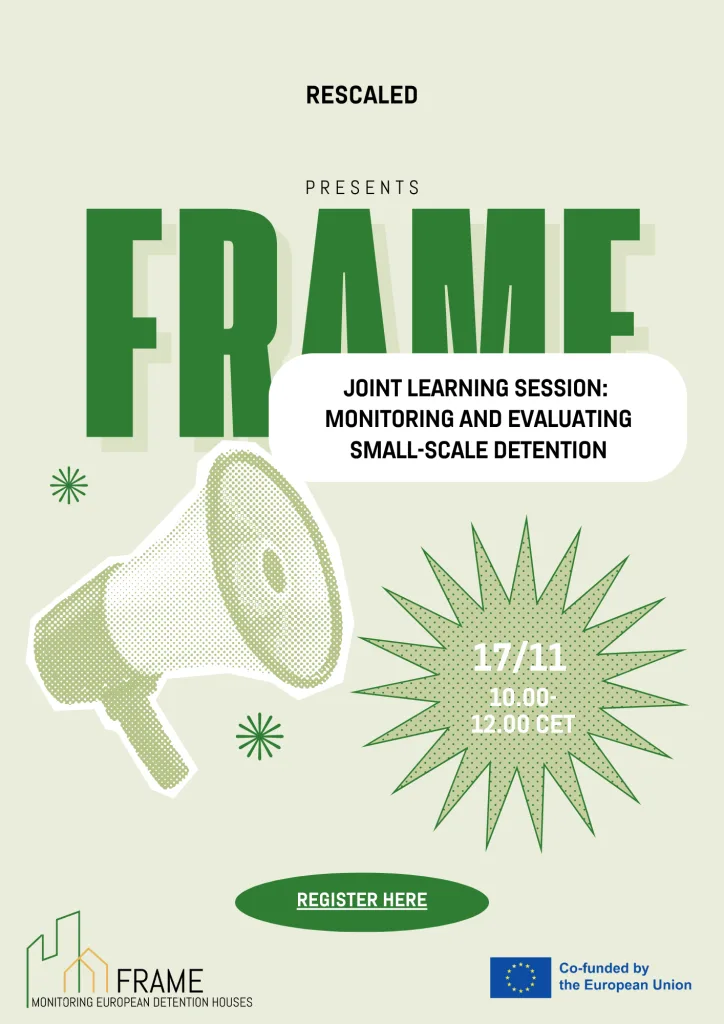
Want to help shape this work? Join a small group of experts for two hours of in-depth discussion:
Joint learning session: monitoring and evaluating small-scale detention
17 November 2026 | 10:00–12:00 CET | Online via Zoom
In collaboration with Associazione Antigone, Irish Penal Reform Trust and Penal Reform International
About FRAME:
FRAME (Frameworks for Realising, Assessing and Monitoring Small-scale Detention in Europe) is a two-year European project that aims to strengthen how small-scale detention is assessed, implemented and monitored across Europe. As small-scale detention increasingly replaces large prison institutions, FRAME develops practical tools and a comprehensive monitoring framework to ensure that detention houses are measurable, comparable across countries, and embedded within human rights, evidence-informed policy and positive societal impact.
By integrating the Sustainable Development Goals into detention monitoring, FRAME creates opportunities to strengthen cooperation between small-scale detention and actors working in health, education, employment, housing, environmental sustainability, local governance and community development.
The project brings together four organisations with complementary expertise in justice reform: RESCALED (Belgium – European), Associazione Antigone (Italy), Irish Penal Reform Trust (Ireland), and Penal Reform International (the Netherlands – International).

Co-funded by the European Union. Views and opinions expressed are however those of the author(s) only and do not necessarily reflect those of the European Union or the European Education and Culture Executive Agency (EACEA). Neither the European Union nor EACEA can be held responsible for them.
- General comment No. 1 (2024) on article 4 of the Optional Protocol (places of deprivation of liberty) (https://docs.un.org/en/CAT/OP/GC/1). ↩︎
- The CPT is currently working on new standards for social care homes. Its existing standards for social care establishments already state that such places should be visited regularly by an independent outside body. See also: https://rm.coe.int/1680a0cc19. ↩︎
- Belgian National Preventive Mechanism (FIRM-IFDH), Bezoekrapport detentiehuizen van Vorst en Kortrijk [Visit report on the detention houses of Forest and Kortrijk], 23 March 2026, https://federaalinstituutmensenrechten.be/nl/publicaties/bezoekrapport-detentiehuizen-van-vorst-en-kortrijk; Belgian National Preventive Mechanism (FIRM-IFDH), Bezoekrapport transitiehuizen van Gentbrugge, Leuven en Edingen [Visit report on the transition houses of Gentbrugge, Leuven and Enghien], 5 August 2026, https://federaalinstituutmensenrechten.be/nl/bezoekrapport-transitiehuizen-van-gentbrugge-leuven-en-edingen. ↩︎
- SPT Report on the visit to Romania, CAT/OP/ROU/1 (2018), para 127. ↩︎